


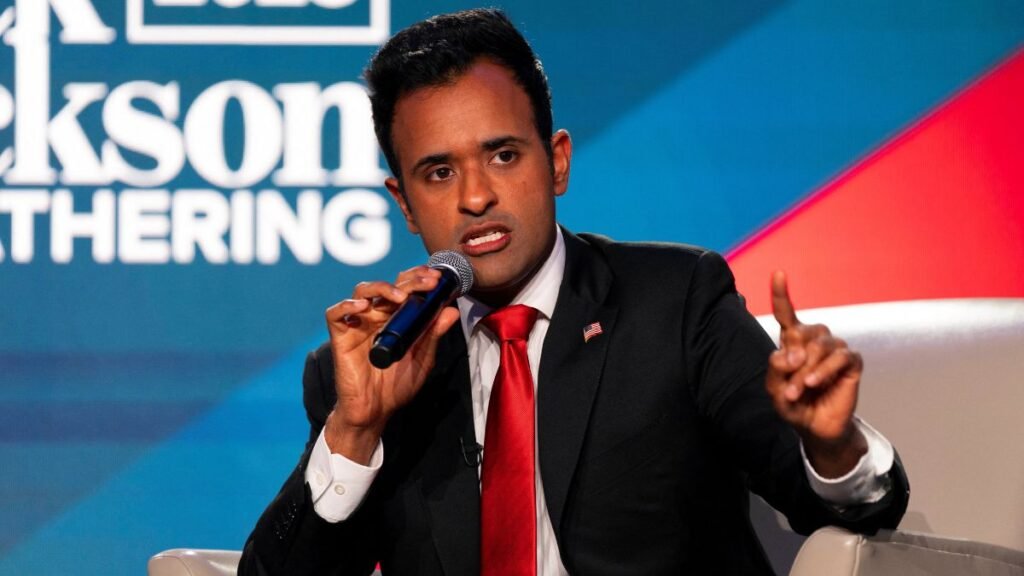
In a second Republican presidential debate at the Ronald Reagan Presidential Library and Museum in Simi Valley, California, Indian-American presidential aspirant Vivek Ramaswamy has reignited the debate on immigration and citizenship in the United States. Ramaswamy, sharing the stage with prominent candidates including Florida Gov. Ron DeSantis and former United Nations Ambassador Nikki Haley, advocated for ending birthright citizenship and overhauling immigration policies.
Ramaswamy, the son of Indian immigrants, responded to a question about the legal basis for expelling undocumented immigrants and their American-born children from the country by reviving a 2015 proposal from then-presidential candidate Donald Trump. This proposal aimed to terminate birthright citizenship, a longstanding practice granting citizenship to individuals born on U.S. soil.
The debate centered on the interpretation of the citizenship clause within the 14th Amendment of the U.S. Constitution, which states, “All persons born or naturalized in the United States, and subject to the jurisdiction thereof, are citizens of the United States and of the State wherein they reside.” While this clause has traditionally been understood as granting citizenship to those born on U.S. soil, some legal scholars argue that the phrase “and subject to the jurisdiction thereof” allows for government discretion, similar to other constitutional principles.
Ramaswamy’s argument contended that children born in the United States to undocumented immigrants should not be granted citizenship, as their parents had violated immigration laws by residing in the country without proper authorization.
In addition to his stance on birthright citizenship, the 38-year-old candidate expressed support for fellow candidates on a range of immigration-related issues. This included advocating for the militarization of the southern border, defunding “sanctuary cities,” and ending foreign aid to Mexico and Central America. Ramaswamy took a further step by calling for the termination of birthright citizenship for the offspring of illegal immigrants, distinguishing himself in a crowded field of Republican presidential contenders.
Ramaswamy’s views on immigration extend to the H-1B visa program, a topic of significant interest to Indian IT professionals. He proposed replacing the current “lottery” system with a “meritocratic” skill-based immigration scheme aligned with the economic needs of the United States. It’s worth noting that Ramaswamy himself has utilized the H-1B visa program multiple times. According to Politico, between 2018 and 2023, U.S. Citizenship and Immigration Services approved 29 applications from his former company, Roivant Sciences, to hire employees under H-1B visas.
Following his inaugural Republican presidential primary debate in August, where Time Magazine referred to him as “Trump’s heir apparent,” Ramaswamy has garnered significant attention. The first poll conducted after the debate indicated that 28 percent of 504 respondents believed Ramaswamy had delivered the best performance.
Ramaswamy’s bold policy proposals and outspoken stance on birthright citizenship and immigration reforms continue to be defining aspects of his campaign, setting him apart in the competitive Republican primary field.
Sources By Agencies
