


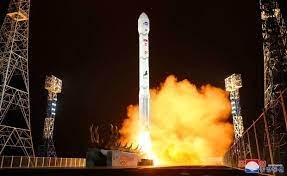
North Korea’s attempt to launch a military reconnaissance satellite ended in a dramatic fireball as the rocket exploded just minutes after liftoff. The failed launch, which took place on Monday, showcased the country’s ongoing efforts to advance its space capabilities but also raised questions about the reliability of its new rocket technology.
According to reports, North Korea’s latest attempt utilized a new “liquid oxygen and petroleum engine” during the rocket’s first stage. However, shortly after liftoff, the rocket exploded and plummeted into the Yellow Sea. State media KCNA reported that the failure occurred during the first stage of flight, pointing to potential issues with the newly developed rocket motor.
Analysts noted that this latest rocket was likely different from the Chollima-1 rocket used in a successful satellite launch in November 2023. The Chollima-1, despite previous test failures, used hypergolic fuels that ignite upon contact, whereas the new rocket’s use of liquid oxygen suggests a shift in propulsion technology.
The involvement of a petroleum fuel and liquid oxygen engine hints at possible assistance from Russia, known for its expertise in such propulsion systems. Russian experts have reportedly visited North Korea to aid in the satellite and space rocket program, although the specifics of this assistance remain undisclosed.
Experts speculate that North Korea’s switch to this engine type could be a strategic move to separate its civilian space program from its ballistic missile activities, which are prohibited by UN Security Council resolutions. However, the failure of the recent launch highlights the technical challenges involved in such advancements, including combustion instability and extreme temperature requirements.
Despite the setback, analysts believe North Korea could analyze the data from the failed launch and potentially relaunch in the future. South Korea’s military released footage of the failed launch, showing an explosion in the sky followed by flashes, while Japan captured a similar ball of flame from its border city of Dandong.
The launch drew condemnation from nuclear envoys of South Korea, the United States, and Japan, who denounced it as a violation of UN Security Council resolutions. The timing of the launch, coming hours after a rare three-way summit between China, South Korea, and Japan, adds a diplomatic dimension to the incident, highlighting ongoing tensions in the region regarding North Korea’s missile and space programs.
Sources By Agencies
