


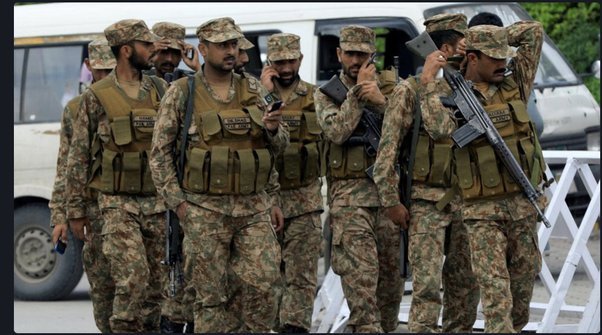
In a brazen act of terrorism, nine heavily armed terrorists launched an attack on the Mianwali Training Air Base of the Pakistan Air Force in Punjab province. The Pakistan Army swiftly responded to the threat, resulting in the elimination of all assailants, who were declared to have been “sent to hell.”
The attack on the Pakistan Air Force training base occurred just a day after the country was rocked by three separate terrorist strikes that claimed the lives of 17 soldiers. The terrorists targeted the Mianwali base, causing damage to three aircraft that were already phased out and non-operational.
While no harm was inflicted on the operational assets of the Pakistan Air Force, the attackers managed to cause damage to these non-operational aircraft. The military promptly initiated a “combing and clearance operation” in the vicinity of the airbase to neutralize any potential threats that may persist following the failed attack.
The Tehreek-i-Jihad Pakistan (TJP), a newly emerged terrorist group affiliated with the Tehreek-i-Taliban Pakistan (TTP), claimed responsibility for the assault in a statement released to the media.
Caretaker Prime Minister Anwaarul Haq Kakar strongly condemned the attack, reaffirming the nation’s unwavering commitment to resisting any attempts to undermine its security.
The attack on the Mianwali Air Base unfolded in the wake of a series of terror incidents that shook the Balochistan and Khyber Pakhtunkhwa provinces, resulting in the loss of 17 soldiers. Fourteen soldiers lost their lives in an ambush by terrorists while traveling from Pasni to the Ormara area of Gwadar district in Balochistan. This incident marked the heaviest toll incurred by the military in Balochistan this year, following the end of a ceasefire agreement between the TTP and the Pakistan government in November 2022.
Hours prior to the Gwadar attack, a series of bomb blasts targeted convoys of police and security forces in the Dera Ismail Khan district of Khyber Pakhtunkhwa, claiming the lives of one soldier and five others, while leaving 24 more wounded. Additionally, two soldiers were killed in another attack in Lakki Marwat district in the same province.
Interim Interior Minister Sarfraz Bugti highlighted that although the names of the terrorists behind the Friday and Saturday attacks may differ, the underlying enemy remains the same. He described the current wave of terror as a “conspiracy to make Pakistan a target of uncertainty and instability once again.”
Throughout the year, Pakistan has faced increased violence, with terrorists and separatists primarily targeting security forces in the troubled Balochistan province. These incidents have intensified since the Taliban assumed power in neighboring Afghanistan in August 2021.
A report by the Pakistan Institute for Conflict and Security Studies (PICSS) revealed that Pakistan witnessed 99 attacks in August, the highest monthly count since November 2014. The Gwadar district has been a hotspot for these attacks, and separatists have targeted Chinese engineers in the area.
The Centre for Research and Security Studies (CRSS), a think tank, noted that security forces lost at least 386 personnel in the first nine months of 2023, marking an eight-year high. Khyber Pakhtunkhwa and Balochistan have remained focal points of violence, accounting for the majority of fatalities and attacks during this period.
Sources By Agencies
