


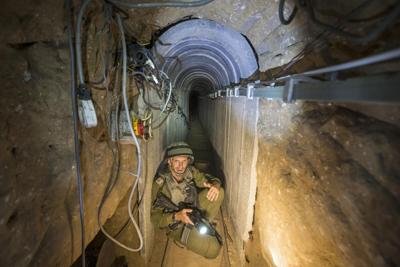
As the conflict in Gaza continues into its 21st day, Israel is faced with a formidable challenge in the form of an extensive tunnel network operated by the Palestinian group Hamas. These tunnels have been a key element in Hamas’s tactics, and the Israeli military has been actively developing innovative solutions to confront this threat.
Since the surprise cross-border attack by Hamas on October 7, the situation in Gaza has escalated, with Israel conducting airstrikes in response. Tragically, more than 7,000 Palestinians have lost their lives in the conflict.
In preparation for a possible ground offensive against Hamas, the Israeli military has moved deeper into Gaza. However, one of the most significant hurdles Israeli troops face is the complex and extensive tunnel system utilized by Hamas. This network is not only a means of transportation but also a means of taking hostages.
Hamas’s tunnel system is vast, with tunnels hundreds of kilometers long and reaching depths of up to 80 meters beneath the 360-square-kilometer coastal strip and its borders. To counter this challenge, Israel has reportedly developed a unique weapon known as “sponge bombs.”
These “sponge bombs” are designed to create a sudden explosion of foam that expands rapidly and hardens, sealing off tunnel entrances or gaps through which Hamas operatives may emerge. Unlike traditional explosives, these devices contain no explosives and are encased within a protective plastic container, featuring a metal barrier that separates two distinct liquids. When activated, these liquids combine and move towards their intended target.
The Israel Defense Forces (IDF) have been seen deploying these innovative devices during exercises within a mock tunnel system near the Gaza border in 2021. Among the elite units tasked with countering the tunnel threat are the Yahalom, specialist commandos from Israel’s Combat Engineering Corps, known as the “weasels.” These units specialize in locating, clearing, and destroying the intricate tunnel network.
Hamas has been developing its tunnel system for decades, beginning in the mid-1990s. This tunnel network has been a significant factor in Hamas’s dominance in Gaza compared to the Israeli-occupied West Bank. The task of tunneling became more manageable when Israel withdrew its soldiers and settlers from Gaza in 2005, and Hamas gained power through a 2006 election.
As the conflict continues to evolve, innovative solutions like the “sponge bombs” showcase the ongoing efforts by the Israeli military to adapt to the challenges presented by Hamas’s tunnel network.
Sources By Agencies
