


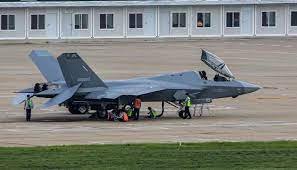
At the Zhuhai Airshow, China has showcased its second fifth-generation fighter jet, the Shenyang J-35, marking a significant milestone in the country’s aerospace capabilities. The J-35, a twin-engine, single-seater supersonic stealth fighter, is designed for multirole combat missions, including air superiority, stealth and counter-stealth operations, and intercepting aerial targets such as fighter jets, bombers, and cruise missiles.
The J-35, developed by Shenyang Aircraft Corporation, is a direct competitor to the US-made Lockheed Martin F-35, the only other aircraft in its class with a similar design. The primary distinction between the two jets lies in the engine configuration: while the F-35 is a single-engine aircraft, the J-35 is powered by two engines. Despite these differences, the overall design of the J-35 bears a striking resemblance to the F-35, continuing China’s trend of drawing inspiration from foreign aircraft designs. This pattern is not new; China’s J-20 has often been compared to the US’s F-22 Raptor, with only minor design differences.
The unveiling of the J-35 at the Zhuhai Airshow underscores China’s growing capabilities in military aviation, making it only the second country after the US to have developed multiple fifth-generation fighter jets. The J-35 is expected to be used by both the Chinese Air Force and Navy, similar to the F-35’s diverse roles within the US military, including variants for the Air Force, Marine Corps, and Navy.
In a related development, China’s latest aircraft carrier, the Fujian, has undergone sea trials. This conventionally powered carrier, which boasts a weight of over 80,000 tons, features an advanced Electromagnetic Aircraft Launch System (EMALS) similar to the one used by the US Navy on the USS Gerald R. Ford. These advancements hint at China’s ambitions to establish a formidable naval air combat force, with the J-35 potentially playing a central role.
The J-35 is also expected to be part of China’s efforts to challenge US military dominance, particularly in the Indo-Pacific region. The inclusion of the fighter jet in the air show signals that it is ready for deployment, further solidifying China’s military presence in the region. Recent developments, including the US Navy’s deployment of the long-range AIM-174B air-to-air missile, add another layer to the shifting balance of power in the Asia-Pacific.
In addition to the J-35, the Zhuhai Airshow also featured several other noteworthy innovations, including a twin-seat variant of China’s J-20 stealth fighter. This new version is touted as a “heavy-duty radar-evading fighter jet with long-range operational and multifunctional capabilities.” The Russian Su-57 fighter jet also participated in the event, highlighting the international significance of the airshow in showcasing cutting-edge military technology.
A dedicated drone zone at the airshow highlighted the growing importance of unmanned aerial vehicles (UAVs) in modern warfare. Drones have proven critical in recent conflicts, such as the ongoing Russia-Ukraine war, and their integration into China’s military strategy is likely to increase.
Moreover, China unveiled the Killer Whale, a new unmanned surface vessel designed for multiple military roles. This vessel, capable of carrying rockets, anti-ship missiles, and ship-to-air missiles, is a part of China’s broader push to modernize its naval capabilities, including deploying unmanned technologies. This development echoes similar initiatives by the US Navy, which has already deployed unmanned ships for sea trials.
In contrast, India’s defense sector continues to make strides in developing its own advanced aircraft. The country’s 5.5-generation Advanced Medium Combat Aircraft (AMCA), currently under development by the Defence Research and Development Organization (DRDO), is expected to join the ranks of next-generation fighters by 2035. India’s latest induction, the Rafale fighter jet, is a 4.5-generation aircraft already deployed along the India-China border to bolster defense capabilities in the region.
As the global balance of power in the Indo-Pacific region continues to evolve, the competition in military aviation is heating up. China’s unveiling of the J-35, alongside other new technologies, signals its commitment to enhancing its air and naval forces, while challenging the dominance of the United States in the region.
With advanced fighter jets, unmanned systems, and state-of-the-art naval platforms on display, the Zhuhai Airshow has proven to be a pivotal moment for China’s military modernization and its growing influence on the global stage.
Sources By Agencies
