


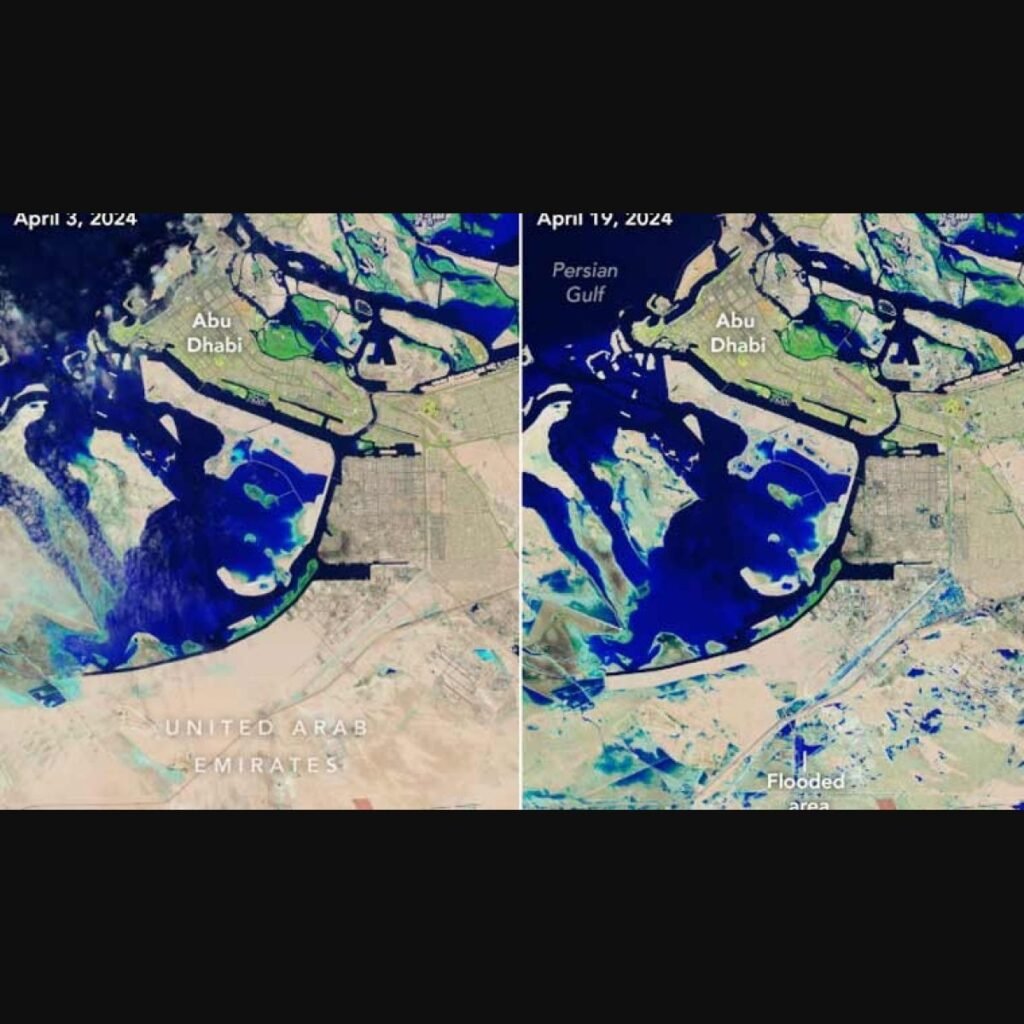
In a visual testament to the extreme weather events gripping the globe, NASA’s Landsat 9 satellite has revealed stunning before and after images of Dubai’s recent floods. These images, taken on April 19, showcase the profound impact of torrential rainfall that inundated parts of the United Arab Emirates (UAE) and brought the bustling city of Dubai to a standstill.
The pictures, captured by NASA’s advanced satellite technology, highlight the contrast between the arid desert landscape and the vast pools of floodwater that emerged after the intense rainstorm. One of the images captures the flooding in Jabel Ali, while another focuses on the submerged areas in Abu Dhabi, the UAE’s capital.
The rainfall, which amounted to more than a year and a half’s worth of rain in a single day, caused flash floods across eastern regions of the UAE, disrupting transportation networks and inundating roads. Particularly striking is the false-color representation used in the images, emphasizing the deep blue hues that signify the presence of water against the typically dry terrain.
Among the affected areas are vital thoroughfares like Sheikh Zayed Road, which connects Dubai and Abu Dhabi, and residential districts such as Khalifa City and Zayed City, all visibly submerged under the floodwaters. The images offer a sobering glimpse into the scale and severity of the natural disaster.
Experts, including Friederike Otto from Imperial College London’s Grantham Institute – Climate Change and the Environment, have pointed to climate change as a significant factor behind the unprecedented rainfall. Otto emphasized the link between heavy rainfall and climate change, cautioning against focusing solely on cloud seeding as a solution.
According to Otto, cloud seeding, a technique aimed at enhancing rainfall, cannot compensate for the broader impacts of human-induced climate change. She warned that continued reliance on fossil fuels like oil, gas, and coal will exacerbate global warming, leading to more frequent and intense rainfall events that pose risks to lives and infrastructure.
Sources By Agencies
