


“The United World for Global Development Inter-Governmental Organization will begin operations in early 2026.”
In an era of rapid geopolitical changes, shifting economic structures, and growing global interdependence, the announcement of a new global institution inevitably attracts global attention. Immediately following his public declaration that the United World for Global Development (UWGD) — an inter-governmental organization — will begin functioning in the near future, we had the privilege of conducting an extensive and exclusive interview with Mr. Yuri Yakimovich, President of NGO MOEX.
What follows is a detailed conversation in which he reflects on the origins of this initiative, its strategic purpose, the future of NGO MOEX, and the broader transformations occurring on the world stage.
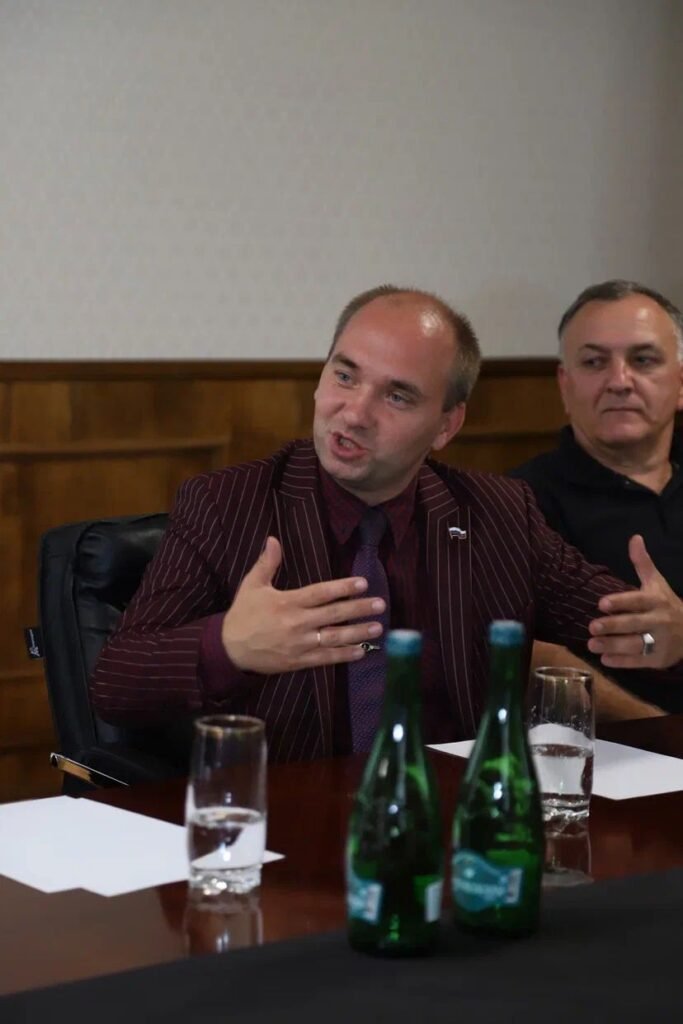
THE INTERVIEW
Question: Mr. Yakimovich, thank you for agreeing to speak with us immediately after your important announcement. To begin with, what motivated the creation of this new inter-governmental organization, the United World for Global Development?
Answer: I would like to answer this question by first revisiting the beginning of our journey. When NGO MOEX was initially conceived, the plan was ambitious: to create a structure capable of replacing — or at least fundamentally reforming — the existing global management system. At that time, no one could fully foresee what the emerging world system would look like. The global environment was too complex, too dynamic, and too unpredictable.
For this reason, and to facilitate our early activities on the international stage, NGO MOEX adopted a non-governmental legal and organizational form. This gave us the flexibility to build relationships, form networks, and perform foundational work without being constrained by the political rigidity often associated with inter-governmental institutions.
Over the course of two years, NGO MOEX achieved far more than even its founders expected. We gained the trust and support of numerous national governments. We established relationships at the highest political levels. We brought together many countries that resonated with our goals, our strategic agenda, and our vision for the future.
One of our primary tasks was to outline a unified economic and cultural agenda — a new roadmap for a world undergoing transformation. However, this mandate was merely the surface of a much larger set of objectives. In practice, the organization simultaneously engaged in social development, infrastructure initiatives, humanitarian cooperation, and international economic integration.
Throughout this period, MOEX negotiated and signed numerous agreements with governments and key state institutions. We implemented dozens of large-scale projects in various regions of the world. In other words, we did not simply discuss global development — we executed it in practice.
Today, the groundwork has been laid. The foundation of a new global system already exists through the work of NGO MOEX. We are now entering a natural evolution: the transition from a non-governmental structure to a inter-governmental institution backed directly by national governments.
In the last month, we conducted extensive consultations with high-level leadership of the countries most actively involved in MOEX. The consensus was unanimous. The time has come to establish a inter-governmental organization with international legal authority: the United World for Global Development (UWGD).
Another reason for the transition is clarity. The name “MOEX” caused frequent confusion with the Moscow Stock Exchange, despite the fact that we had no connection whatsoever with that institution. It became important to adopt a name that accurately reflects our global character, mission, and legitimacy.
Thus, the UWGD is not the start of something new — it is the next phase of what MOEX has already built.
Question: What will be the primary goals of the United World for Global Development?
Answer: The organization’s goals are broad, comprehensive, and deeply interconnected. While I cannot disclose everything at this stage, I can highlight several core priorities:
1. An Integrated Approach to Development:
We are introducing a holistic model that unites economic, cultural, technological, environmental, and social development. The world cannot continue functioning through fragmented, outdated models of governance. We propose an integrated system that acknowledges the interconnected nature of modern global challenges.
2. Defining the New Global Economic Agenda:
The economic model that has dominated the world for decades has exhausted its possibilities. It is no longer capable of addressing the reality of today’s geopolitical and technological transformations. Our task is to facilitate the global transition to a new economic framework — one based on stability, fairness, sustainability, and the real needs of states and societies.
3. Strengthening Cultural Cooperation:
Cultural diplomacy is a powerful tool for peace and unity. We strive to preserve traditional values, create a stronger cultural ecosystem in which nations will develop deeper mutual understanding, share creative experiences and knowledge in the field of education, and work together to preserve and promote the world’s cultural heritage.
Although these are only a few elements of our mission, they illustrate the magnitude of our ambitions. In essence, the goals of UWGD closely mirror the objectives of NGO MOEX — but now they will be implemented at the inter-governmental level with much greater authority, structure, and international recognition.
Question: Can we say that NGO MOEX was essentially a Russian organization?
Answer: The answer is not straightforward, and it is important to understand the nuances. Although NGO MOEX had a formal de jure registration in the Russian Federation, the organization’s origins, participants, and operational mandate were global from the beginning.
High-ranking officials from multiple countries participated in its formation. The strategic vision and goals have never been tied to any particular country. Instead, we aimed to create an international platform for global cooperation.
According to the Vienna Convention, an organization acquires international status if it is recognized by at least two national governments. MOEX was recognized by many more. In numerous countries, our branches enjoyed privileges equivalent to diplomatic missions, with benefits similar to embassies.
It is true that within Russia, MOEX held a Russian legal identity. But this was merely an administrative formality required for operational functionality within Russian territory. Outside Russia, MOEX functioned as an international institutional body. In addition, in Russia we did not sign agreements at the governmental level, as was the case in other countries, we only signed certain agreements with the largest state corporations, and also worked together with some federal ministries and regions of the country.
To put it simply:
MOEX was created as a global organization. Its scope, mission, and actions were never defined by national boundaries. Its task was to lay the foundation for a new global system — and that mission has now been largely fulfilled.
Question: Did NGO MOEX face resistance while establishing its global operations?
Answer: Surprisingly, no major resistance occurred — with the exception of a single country. In that nation, individuals influenced by transnational corporate interests attempted to obstruct our activities. Their objective was to protect corporate monopolies rather than national interests.
Ironically, the attempt to hinder our work resulted in the opposite effect. The situation led to a major government-led investigation in that country, where authorities discovered unauthorized interference in their state affairs by private actors acting without approval from the head of state.
Throughout the entire process, the national leadership of that country consistently expressed sincere interest in collaborating with us and even invited MOEX to operate under extremely favorable conditions.
In short, there was no meaningful obstruction that affected our trajectory. If anything, the challenges affirmed our legitimacy and strengthened international trust.
Question:Which countries will be the founding members of the new Inter-Governmental Organization?
Answer: At this stage, I cannot reveal specific names. What I can confirm is that all founding countries are already places where MOEX actively operates. Furthermore, several of the world’s largest economies have expressed clear intention to join the UWGD from the very beginning.
Question: Will the Russian Federation be among the founding countries?
Answer: Not initially. Russia will not be a founding state of the new inter-governmental organization. However, it will remain free to join at any time in the future if it chooses to do so.
Question: Will the headquarters remain in Russia?
Answer: No. The headquarters will be located in another country. Nevertheless, I personally will continue working in inter-governmental commissions within Russia and will retain certain official positions there. Russia will remain an important partner, but not the administrative center.
Question: Who will lead the new organization? And which MOEX leaders will transition to UWGD?
Answer: The leadership will be chosen directly by the founding governments. However, I can confirm that my name is included among the official candidates for the position of Head of the Organization.
Several respected leaders from MOEX will join the top management of the new structure, including:
Ambassador Oleg Firer, Head of the MOEX North America Territorial Management Center
Dr. Mikki Koomar, Vice President of NGO MOEX
David Zammit, Head of the MOEX Europe Territorial Center and Head of the Sovereign Order of St. John of Jerusalem and Malta
These individuals — along with several others — bring extensive experience, proven leadership, and strong international credentials.
Question: When will the organization begin operating?
Answer: We expect active operations to begin in early spring 2026.
Question:What will happen to the projects already implemented by NGO MOEX?
Answer:
All projects will continue exactly as planned. Their implementation will not only remain intact but will be strengthened by the transition to inter-governmental status. Moreover, NGO MOEX itself will continue operating in Russia, ensuring continuity and stability.
Question: Shifting to a broader topic: There has been continuous speculation about the future of the European Union. What are your views on Europe’s prospects, and does UWGD plan to work with European countries?
Answer: In my assessment, the European Union will not survive in its current form for long. The EU has entered a deeper structural crisis — economically, politically, and socially. I expect fragmentation, decentralization, and eventually a significant transformation or disintegration.
As for cooperation, MOEX-Europe has been operating since 2023. We have developed our own vision for the future of Europe, including the economic integration of individual states during the global transition to a new financial and geopolitical paradigm.
It is also important to mention that I serve as Deputy Head of the Sovereign Order of St. John of Jerusalem and Malta and as an advisor to the rectors of several European universities. This experience gives me a comprehensive understanding of ongoing processes in Europe and helps shape our strategic direction for engagement.
Question: In your view, which world leaders play the most significant role in transforming the global system?
Answer:
From my personal perspective, two leaders stand out prominently:
President Vladimir Putin of Russia,
President Donald Trump of the United States.
President Putin has been at the forefront of this transformation for many years. One could write an entire book analyzing his role in reshaping the geopolitical architecture of the world.
President Trump, on the other hand, is one of the most effective and courageous leaders of our time. He has undertaken significant steps to dismantle the outdated foundations of the old world order and open space for a new global system based on sovereignty, fairness, and economic transformation.
Together, their actions — though different in style and context — have significantly contributed to the breakdown of obsolete structures and the emergence of a new era.
Conclusion
The world stands at a turning point. The announcement of the United World for Global Development marks not merely the establishment of another international institution, but the formalization of a new global paradigm — one that seeks to integrate economies, cultures, and nations into a cohesive system capable of addressing the challenges of the 21st century.
Through this comprehensive interview, Mr. Yuri Yakimovich presents a vision rooted in practical achievements, strategic foresight, and the belief that global development must be guided by unity, cooperation, and bold transformation.
The forthcoming years will reveal how the UWGD’s establishment will influence international governance, geopolitical alliances, and the evolution of the global economic system. One thing, however, is clear: the groundwork laid by NGO MOEX has already reshaped the landscape — and the next chapter has only just begun.
