


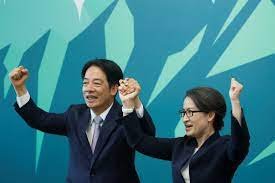
In a strategic move ahead of Taiwan’s upcoming presidential election, Lai Ching-te, the leading candidate for the presidency, announced Hsiao Bi-khim, Taiwan’s former envoy to the United States, as his vice-presidential candidate. The selection comes amidst escalating tensions with China, which has denounced both Lai and Hsiao as separatists.
Hsiao, 52, renowned for her extensive connections in Washington, has been Taiwan’s de facto ambassador to the US since 2020. She joins Lai, the vice president and presidential candidate of the ruling Democratic Progressive Party (DPP), in a bid that has consistently led in opinion polls as Taiwan faces mounting pressure from Beijing to acknowledge its sovereignty.
Expressing shared values with Lai, particularly in defending Taiwan’s freedom and democracy, Hsiao emphasized their alignment in assuming responsibility for the nation’s welfare. As she stood alongside Lai at their campaign headquarters in Taipei, she affirmed their common convictions to reporters.
Acknowledging her resignation as the US envoy earlier in the day, observers highlighted Hsiao’s political acumen and predicted that her diplomatic prowess would enhance Lai’s ticket, bringing essential diplomatic and security expertise if elected.
Despite China’s opposition to both Lai and Hsiao, citing sanctions against Hsiao as an “independence diehard,” the duo remains steadfast in their pursuit of Taiwan’s separate identity. China’s Taiwan Affairs Office labeled them an “independence double act,” prompting Lai to dismiss these remarks as undue intervention in the election.
The Democratic Progressive Party’s seamless nomination contrasts sharply with the struggle among Taiwan’s opposition parties to form a united front. Disputes within the Kuomintang (KMT) and the Taiwan People’s Party have hindered efforts to present a joint ticket, diverging from the cohesion displayed by Lai’s team.
As the deadline for presidential candidate registration approaches, Lai expressed confidence in his well-prepared team, contrasting it with what he referred to as “turmoil” within the opposition camp.
Hsiao, born in Japan to a Taiwanese father and American mother, underscores her Taiwanese identity by using an English spelling of her name based on Taiwanese Hokkien pronunciation.
Sources By Agencies
