


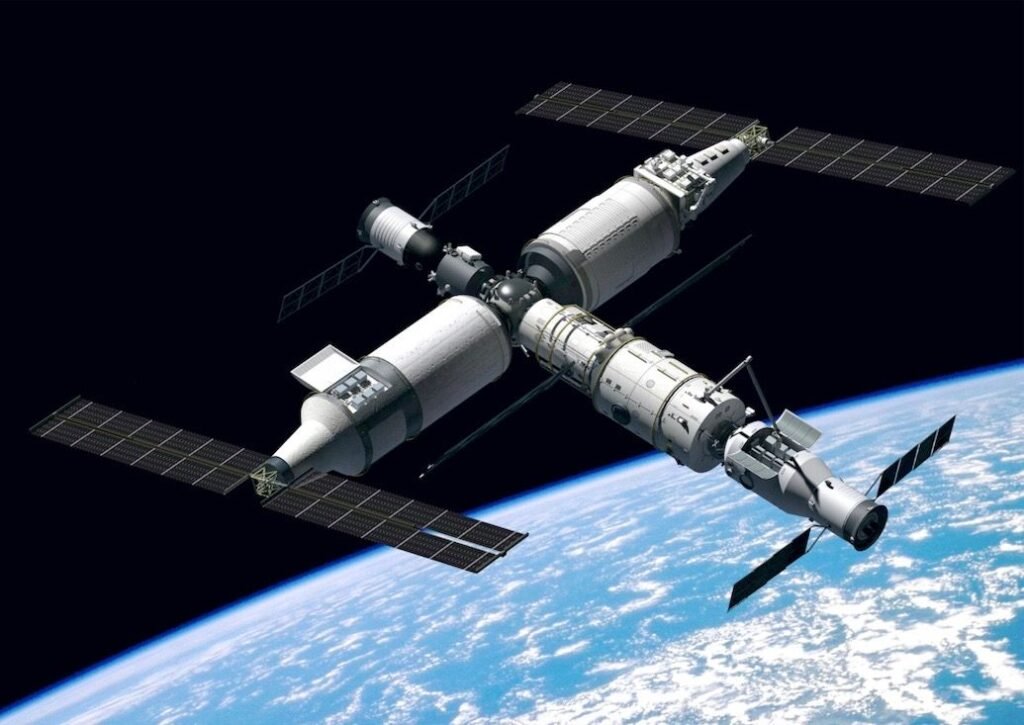
China marked another milestone in its space exploration endeavors as it sent three astronauts to its permanently inhabited space station for a six-month stay. The spacecraft Shenzhou-18, also known as the “Divine Vessel,” along with its crew, lifted off atop a Long March-2F rocket from the Jiuquan Satellite Launch Centre in northwest China at 8:58 p.m. (1258 GMT), according to state media reports.
The mission is part of a regular rotation of Chinese astronauts aboard the “Tiangong” space station, which orbits high above the Earth’s atmosphere. Leading the six-month mission is 43-year-old Ye Guangfu, who previously visited Tiangong in October 2021 during China’s second crewed mission to the station.
Accompanying Ye Guangfu on this journey are Li Cong, 34, and Li Guangsu, 36, both making their first spaceflight and part of the latest batch of astronauts in China’s spaceflight program. All three astronauts have backgrounds as former air force pilots.
Tiangong, meaning “Heavenly Palace” in Chinese, was completed in late 2022 and can accommodate up to three astronauts for extended periods at an orbital altitude of up to 450 km (280 miles). The station has a designed operational lifespan of at least 15 years.
Since the start of construction of Tiangong in 2021, China has been conducting two crewed missions to the station annually, with Shenzhou-18 being the seventh such mission. During their stay, the astronauts will conduct spacewalks and perform scientific experiments in the station’s low-gravity environment.
The Tiangong space station has become a symbol of China’s growing confidence in its space capabilities, especially after being excluded from the NASA-led International Space Station due to U.S. laws prohibiting collaboration with China in space endeavors.
Sources By Agencies
