


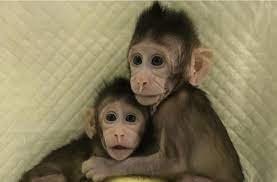
Chinese researchers have accomplished a groundbreaking feat by successfully cloning a rhesus monkey, a significant advancement in primate cloning technology. This achievement, reported over 25 years after the cloning of Dolly the sheep, holds immense promise for medical research due to the physiological similarity of rhesus monkeys to humans, facilitating accelerated drug testing.
Previous attempts at cloning rhesus monkeys faced challenges, with either no successful births or offspring succumbing within hours. In sexual reproduction, offspring inherit a combination of genes from both parents, while cloning involves creating a genetically identical copy of a single animal.
Dolly the sheep, the most famous cloned animal, was created in 1996 through the reprogramming of skin cells into embryos, which were then implanted into a surrogate mother. The successful cloning of the rhesus monkey follows a similar process, as outlined in a report published in the journal Nature Communications.
The cloned rhesus monkey, born in Beijing, has defied previous obstacles, remaining healthy for over two years since its birth. Dr. Falong Lu from the University of Chinese Academy of Sciences expressed joy, stating that “everyone was beaming with happiness” at the successful outcome.
However, the achievement has raised ethical concerns, with the UK’s Royal Society for the Prevention of Cruelty to Animals (RSPCA) asserting that the suffering experienced by the cloned animal outweighs any immediate benefits to human patients. The success of primate cloning opens new doors for medical advancements but sparks debates about the ethical implications surrounding the use of cloning technology in scientific research.
Sources By Agencies
