


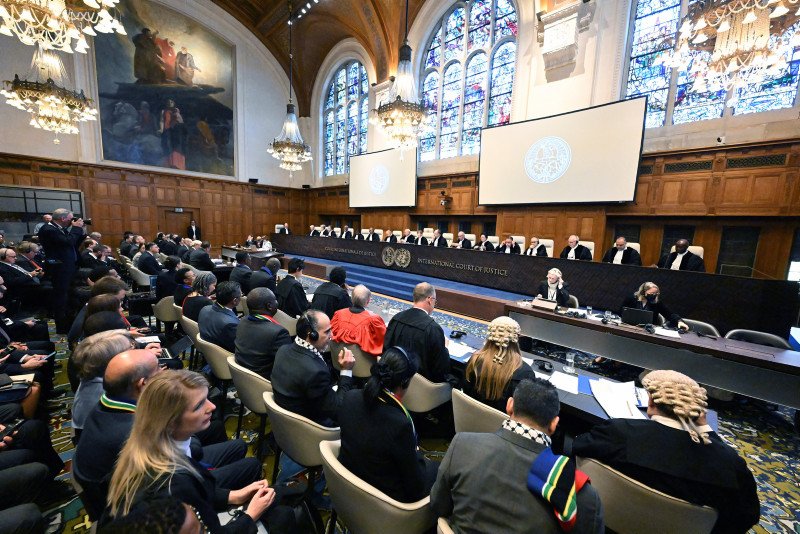
In a significant move, South Africa has brought charges of genocide against Israel to the International Court of Justice (ICJ), alleging genocidal acts in Gaza. This legal confrontation is not only a stand for justice but is also perceived as a strategic move to boost South Africa’s international standing and rally domestic support in the lead-up to elections.
A legal team, including experts in international law and seasoned litigators, has been assembled by South Africa for this 84-page submission to the ICJ. The team argues for urgent measures to halt Israel’s military operations in Gaza, citing ongoing violence since the October 7 attacks by Hamas, resulting in the death of at least 1,200 Israelis, predominantly civilians.
The historical context of South Africa’s support for Palestine dates back to its anti-apartheid struggle. The ruling party, the African National Congress (ANC), has consistently aligned itself with the Palestinian cause, drawing parallels between its fight against apartheid and the struggle of the Palestinians. Nelson Mandela himself emphasized the interconnectedness of South Africa’s freedom and the freedom of the Palestinians, stating that South Africa’s freedom would be “incomplete without the freedom of the Palestinians.”
However, experts suggest that beyond principled support, there may be political motivations behind South Africa’s legal move. The ANC, currently facing corruption allegations and a decline in domestic support, sees the ICJ case as an opportunity to regain legitimacy and divert attention from domestic challenges. By taking a principled stand on the international stage, the ANC aims to reinforce its core values and demonstrate its commitment to justice.
The move has elicited mixed reactions within South Africa. President Cyril Ramaphosa expressed the country’s duty to support the Palestinians, citing the ongoing violence. Yet, opinions vary, with South Africa’s Jewish Board of Deputies labeling the move a “media-seeking stunt” and alleging rising anti-Semitism.
Israel has vehemently rejected the charges, with government spokesman Eylon Levy dismissing them as an “absurd blood libel.” Israeli President Isaac Herzog affirmed that the country would proudly present its case of self-defense in the ICJ, emphasizing the military’s efforts to avoid unintended consequences and civilian casualties.
South Africa’s case against Israel carries broader international implications. As a member of BRICS, a group seen as a counterbalance to the Western-dominated international order, the move may strain diplomatic relations with countries closer to Israel, such as India.
The ICJ proceedings are awaited with global attention, as this legal showdown unfolds against the backdrop of geopolitical complexities and historical commitments.
Sources By Agencies
